
Temperature sensors
Temperature sensors from KMT Heiztechnik capture process temperatures precisely and reliably: thermocouples Type J, K and L as well as resistance sensors Pt100 and Pt1000 — in designs from bayonet to sheathed sensors, made up to your specifications and supplied from quantity one.
Measure, don't estimate
Any control is only as good as its measuring point.
The temperature sensor captures the process temperature and passes it to the controller as an electrical signal — it is thus the link between heater and controller. We supply sensors to match the measuring point, controller and environment, made up to your specifications.
Two measuring principles cover all applications: thermocouples (Type J, K, L) use the thermoelectric effect of two metals — robust, fast and high-temperature resistant. Resistance sensors (Pt100, Pt50, Pt1000) measure via the temperature-dependent resistance of platinum — highly accurate in class A or B, optionally in 2-, 3- or 4-wire configuration.
Two measuring principles
Thermocouples (Type J, K, L) for fast, robust measurement — resistance sensors Pt100/Pt1000 for the highest accuracy in class A or B.
Designs for every measuring point
Bayonet, screw-in, surface and sheathed types — plus angled, clamp and pipe-clamp designs for every mounting situation.
Leads up to 550 °C
Insulation made of glass silk, PTFE, silicone or Kapton, protected with steel or stainless steel braid — matched to the environment at the installation site.
From quantity one
From a single replacement sensor to series requirements — also as an exact replacement for third-party products based on a sample part or nameplate.
Specifications
Technical data
Precision measurement technology for demanding thermal applications. Every temperature sensor is made up individually for you based on these technical standards.
| Thermocouples | Type J, Type K (DIN EN 60584), Type L (DIN 43710) |
| Accuracy of thermocouple leads | Class 1 |
| Application range, standard design | Type J up to 300 °C, Type K up to 750 °C |
| Resistance sensors | Pt100, Pt50, Pt1000 — accuracy class A or B |
| Connection technology (Pt) | 2-, 3- or 4-wire configuration |
| Sensor tip (bayonet) | ø 6 or 8 mm |
| Insertion depth | 15 – 150 mm |
| Bayonet cap | Nickel-plated steel |
| Measuring point | Hard-soldered, flat or 118° drill angle |
| Lead Type J/K | 2 × 0.22 mm², glass silk, metal braid sheath |
| Lead PT100 | 4 × 0.22 mm², glass silk, metal braid sheath |
| Lead temperature resistance | 400 °C (standard) / 550 °C (special) |
| Lead insulations | Glass silk, PTFE, silicone, Kapton, PVC |
For every measuring point
Designs & configurations
Bayonet sensor
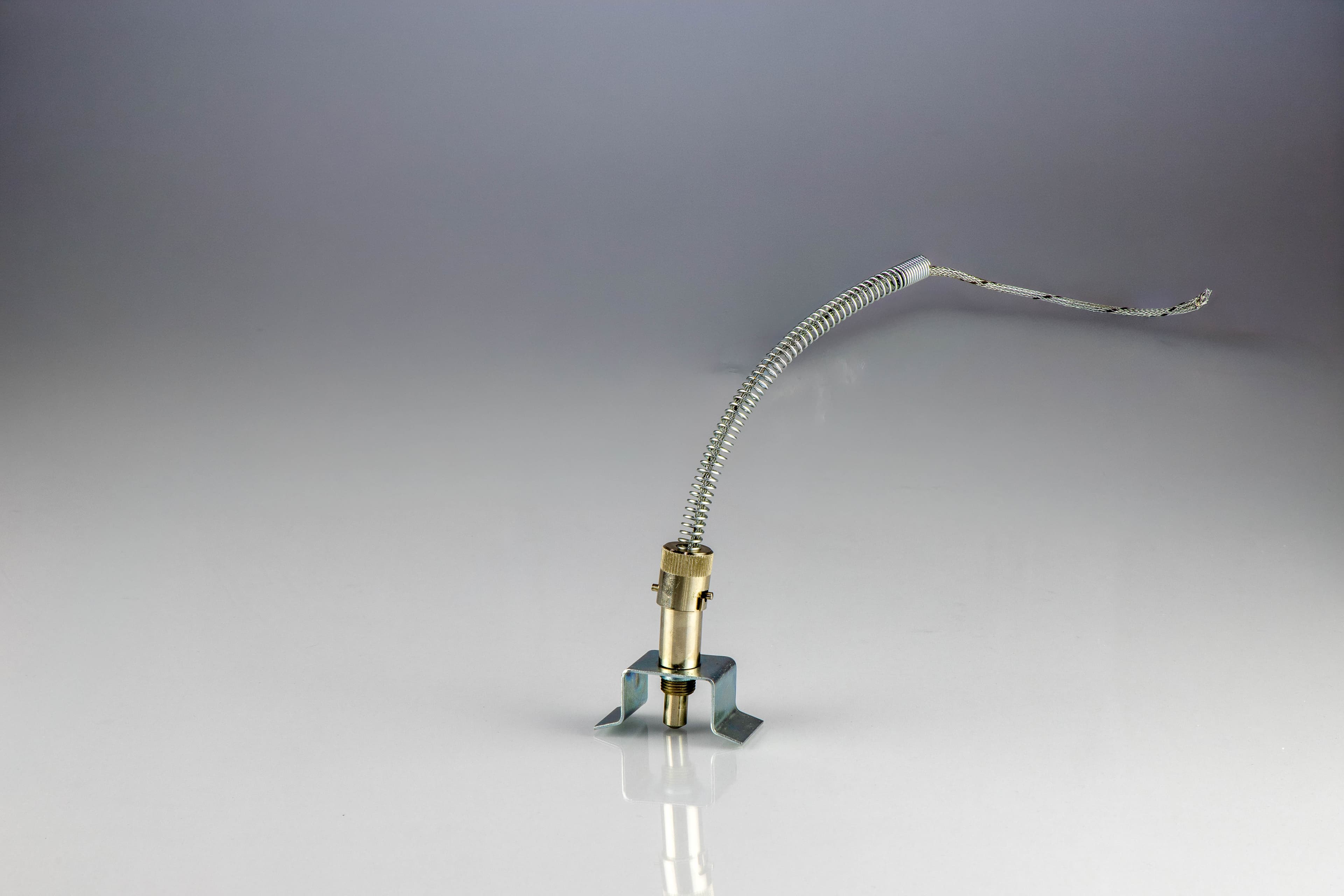
Spring-loaded measuring tip (ø 6 or 8 mm) with nickel-plated bayonet cap — the standard on injection molds and heating zones.
Screw-in sensor
With nipple G 1/4″, G 3/8″ or metric thread (M10 – M14) screwed directly into the measuring bore.
Surface & contact sensors
Measures externally on the component — as a surface, clamp or pipe-clamp sensor, without intervening in the process.
Sheathed sensor
Flexible sheath, fixable via compression fitting (ø 1.5 / 3 / 6 / 10 mm) — also available in angled or plug-in design.
Options & accessories
From the thermo connector to the compression fitting — the configuration depends on the controller, measuring point and environment.
Expertise
Application areas
Injection molds and hot runner tools
Plastics processing
Industrial processes
Heating systems
Chemical industry
Food production
Laboratory and testing technology
Technical documentation
* Documentation available on request already now — please use our form.
FAQ
Frequently asked questions
No. We supply temperature sensors from a quantity of one — from a single replacement sensor for a heating zone to series requirements. Every sensor is assembled to order according to your specifications.
Thermocouples (type J, K, L) are robust, respond quickly and cover high temperatures — the standard in tool and heating-zone measurement. Resistance sensors (Pt100, Pt1000) measure more accurately and with better long-term stability — in accuracy class A or B, as a 2-, 3- or 4-wire circuit. The input of your controller is also decisive: tell us the controller and measuring task, and we will recommend the right sensor.
Type J (Fe-CuNi) is the standard in plastics processing, type K (NiCr-Ni) covers higher temperatures up to 750 °C, type L (Fe-CuNi per DIN 43710) is found mainly on existing machinery. Important: sensor type and controller input must match — if in doubt, a photo of the nameplate on the controller or old sensor is sufficient.
The number of wires determines how well the lead resistance is compensated: the 2-wire circuit is the simplest variant for short leads, the 3-wire circuit is the industry standard, and the 4-wire circuit measures most accurately. Which variant your controller supports is specified in its wiring diagram.
The measuring tip sits spring-loaded in a bayonet cap: on insertion, the spring is tensioned and presses the tip permanently against the bottom of the measuring bore — the measuring point stays pressed in place even under vibration and thermal expansion. This is why bayonet sensors are the standard on injection molds and heating zones.
Leads with glass-silk, PTFE, silicone, Kapton or PVC insulation, temperature-resistant up to 400 °C (standard) or 550 °C (special), protected with steel or stainless steel braid. As a connection: open ends, type J/K/L thermocouple plugs in standard or miniature versions, or Tuchel connectors — depending on the mating connector on your machine.
Yes. Send us the old part or the key data (sensor type, tip diameter, insertion depth, lead length, connector type) — we assemble an equivalent replacement, regardless of the original manufacturer.
You provide us with sensor type, design, dimensions and connection type — if in doubt, a photo of the old part and nameplate is enough. We check the information, clarify any open points directly with you and deliver the fully assembled sensor after ordering.
Our range
More products
Inquiry checklist
This is what we need for your quote:
- 01Sensor type: type J or type K thermocouple, alternatively PT100 (on request)
- 02Measuring range or maximum process temperature at the measuring point
- 03Design and installation situation: bayonet sensor, screw-in sensor, surface sensor — incl. diameter of the sensor tip
- 04Insertion depth or length of the sensor shaft
- 05Measuring point: flat or with drill angle (matching the existing sensor bore)
- 06Lead length and lead design (insulation, metal-braid sheath, strain-relief spring)
- 07Connection: open ends, connector or customer-specific
- 08Quantity — and, if available: drawing or old part
Request a Product
Free and non-binding — sent directly to our technical sales team.