
Nozzle band heaters
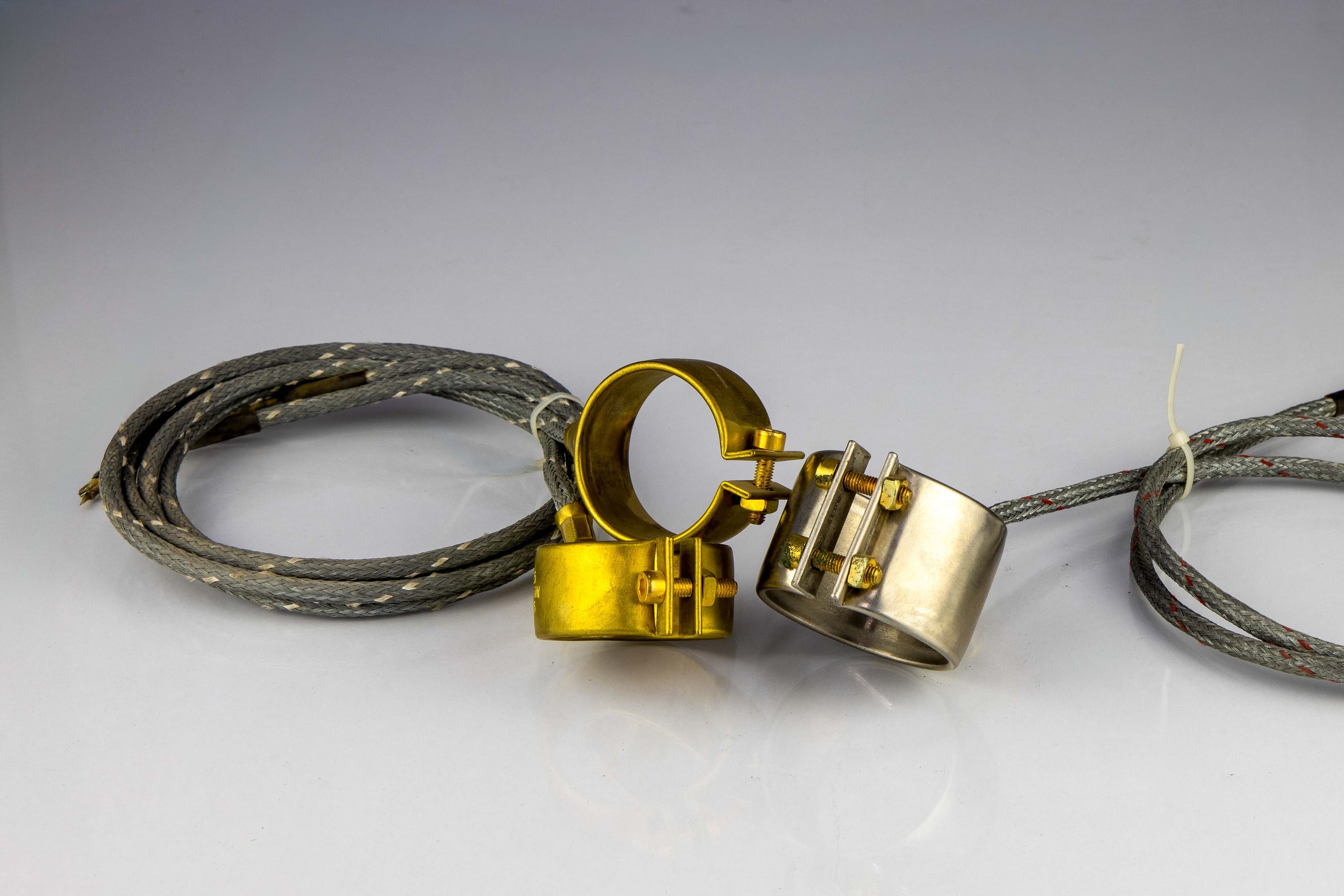
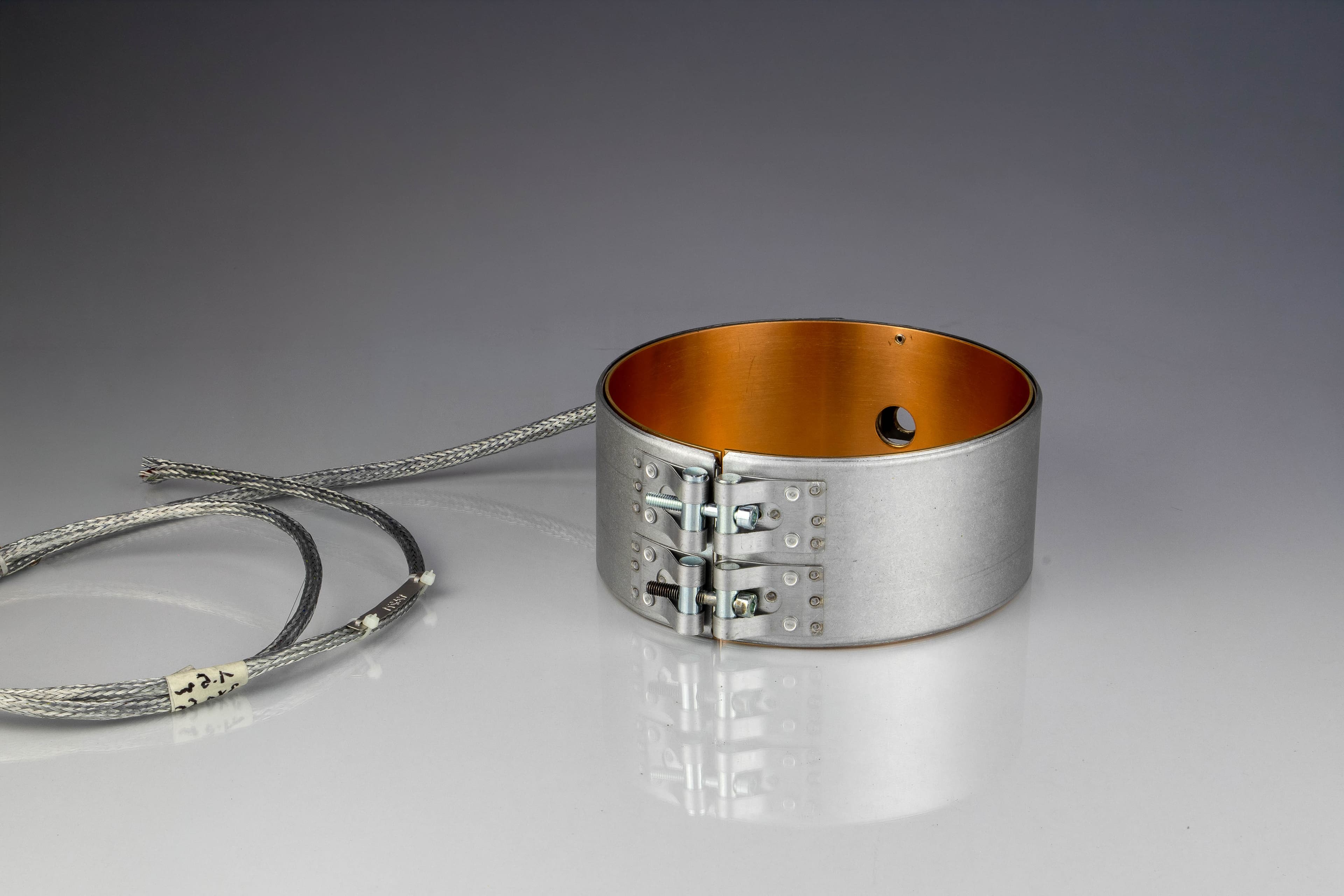
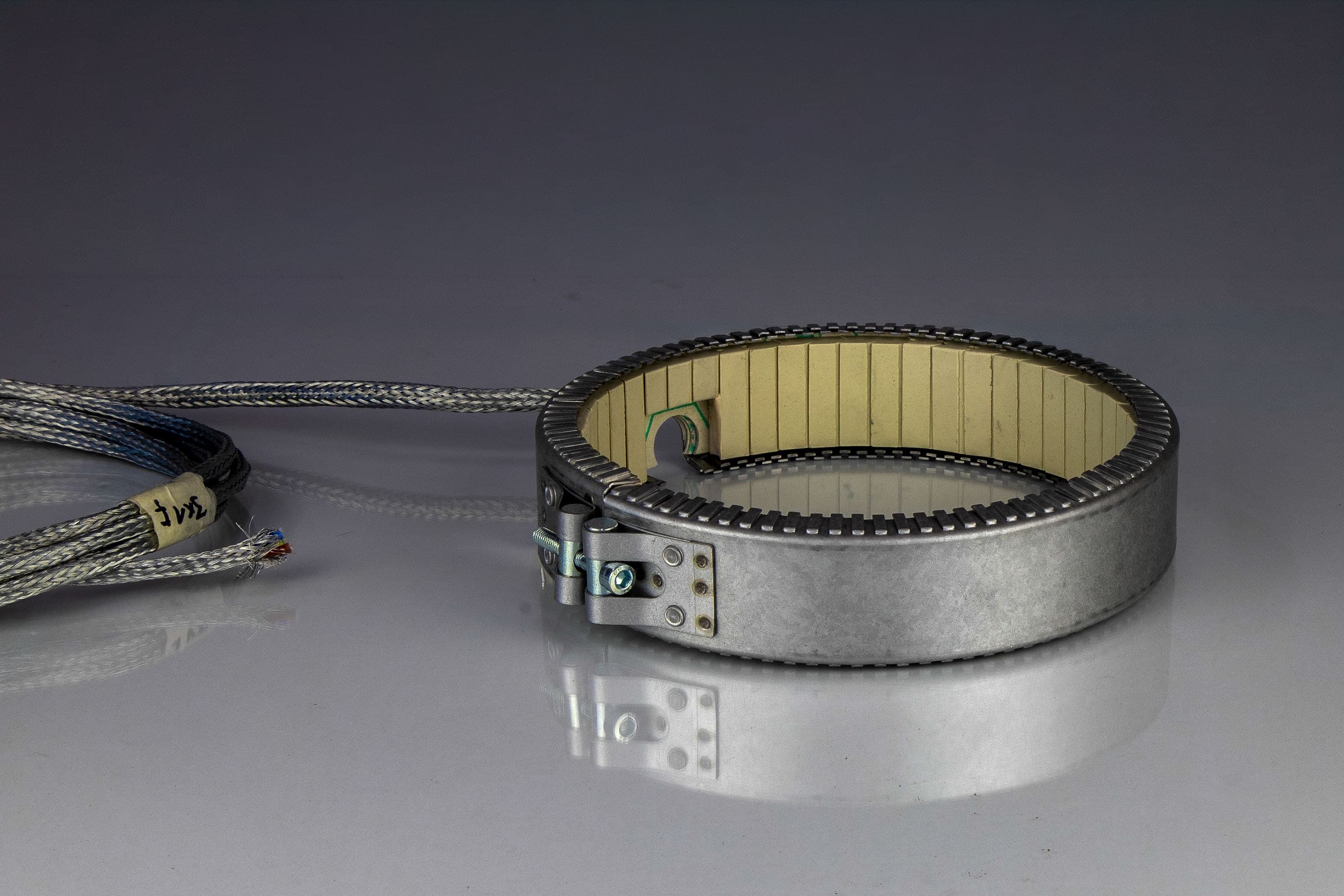
Nozzle band heaters from KMT Heiztechnik are custom-made heating elements for even, reproducible heating of nozzles on injection molding and extrusion machines. With brass or stainless steel casing, temperatures up to 500 °C and watt densities up to 9.0 W/cm² — supplied from quantity one, exactly to your dimensions.
Precision at the nozzle
Even heat at the most critical point
of the machine.
The nozzle is the transfer point between cylinder and mold — if the temperature fluctuates here, shot weight and surface quality suffer. Nozzle band heaters deliver defined, reproducible nozzle temperatures in minimal installation space. We supply every band heater custom-made to your specifications — from quantity one.
The brass or stainless steel casing forms itself precisely around the nozzle and transfers heat across the entire contact surface. Two designs cover the power range: the standard design with 3.5 mm wall thickness up to 6.5 W/cm², and the high-performance design with 5.0 mm wall thickness up to 9.0 W/cm². The connection can be made axially, radially or tangentially — in six lead-out types.
Up to 500 °C and 9.0 W/cm²
High temperatures and watt densities up to 9.0 W/cm² (high-performance design) in minimal installation space — designed for the tight mounting conditions at the machine nozzle.
Brass or stainless steel
Two casing materials: brass with very good thermal conductivity for standard applications, stainless steel for higher process temperatures and aggressive environments.
Temperature measurement of your choice
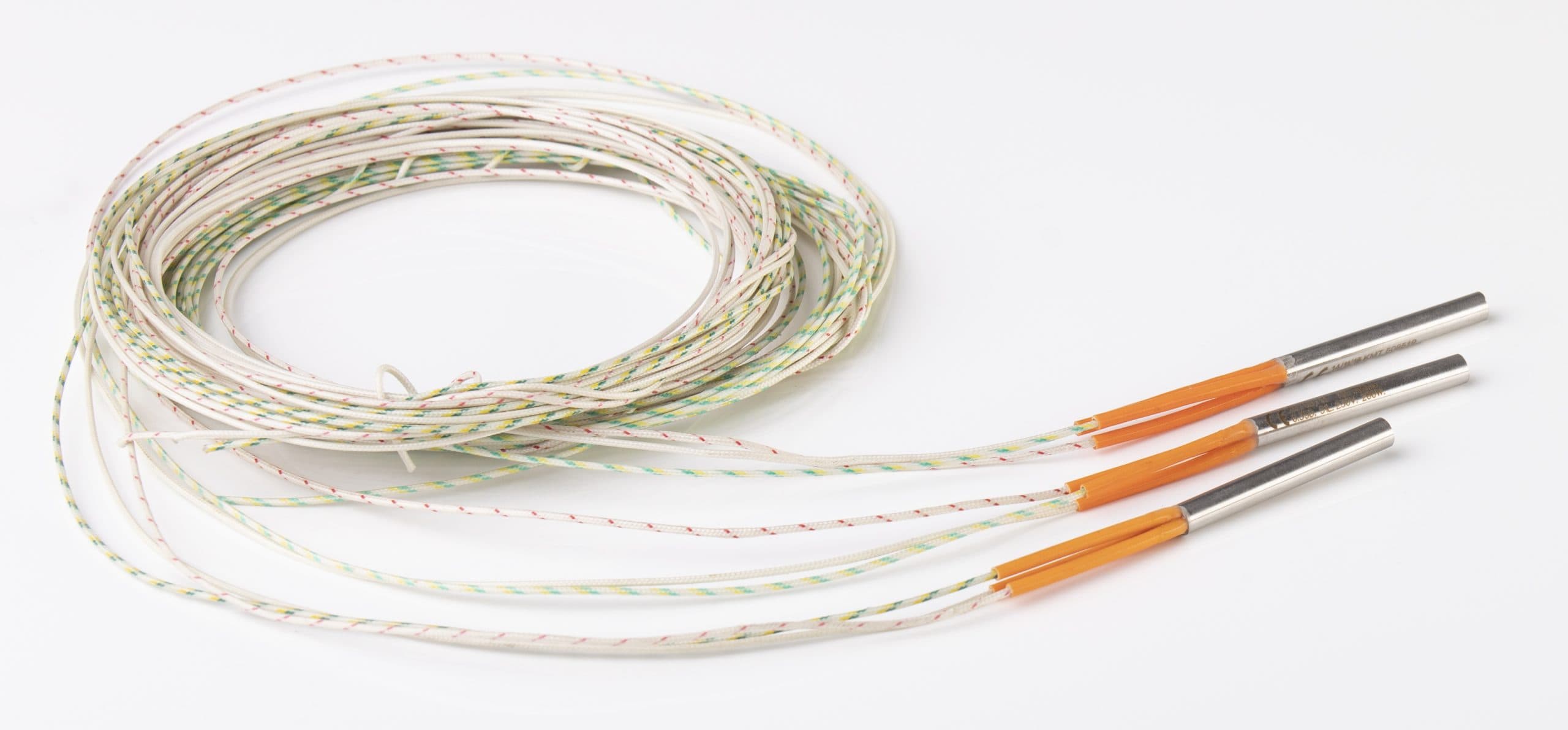
Integrated sensor (Type J, Type K or PT100), connection for external sensors, or underlay sensors — often the only practical solution on small nozzles.
From quantity one
From replacing a single defective band heater to equipping the entire machine fleet — also as an exact replacement for third-party products.
Specifications
Technical data
Precision heating elements for demanding thermal applications. Every nozzle band heater is designed individually for you based on these technical standards.
| Casing material | Brass or stainless steel |
| Inner diameter | 28 – 110 mm (special sizes on request) |
| Width | 20 – 80 mm |
| Wall thickness | 3.5 mm (standard) / 5.0 mm (high-performance) |
| Temperature | up to 500 °C |
| Watt density | up to 6.5 W/cm² (standard) / up to 9.0 W/cm² (high-performance) |
| Voltage | up to 440 V |
| Power | As required, up to the maximum possible watt density |
| Power tolerance | ±10% |
| Dielectric strength | 1,000 V AC |
| Insulation resistance | 1 MΩ (500 V DC, cold state) |
| Degree of protection | IP 40 |
| Connection lead | Nickel lead, glass-silk insulated, steel-braid sheathed |
Safety notes
Mounting & safety
Proper mounting is a prerequisite for the function, service life and operational safety of your heating system.
!Full-surface fit on the nozzle
The band heater must sit in full-surface contact with the nozzle around its entire circumference. Air gaps drastically impair heat transfer — the energy does not reach the nozzle and the band heater overheats at these points.
- Tighten the clamping mechanism evenly — snug fit, without deforming the casing.
- The nozzle expands during heat-up — check the fit once operating temperature is reached and readjust if necessary (only while de-energized).
For cable routing, the following applies: no tensile forces on the connection area, observe the minimum bending radius of the connection lead, and route the lead away from the hot zone. Metal braid, stainless steel corrugated hose or metal protective hose are available as kink protection.
Mounting check
- 01Nozzle surface clean & burr-free
- 02Band heater in full-surface contact — no air gap
- 03Tighten clamping mechanism evenly
- 04Check fit after the first heat-up & readjust
- 05Do not kink connection cable — observe bending radius
- 06Observe strain relief at the connection
- 07Mount only de-energized & cooled down
- 08Commission only with temperature control / monitoring
Range of designs
Designs & options
Standard
Proven standard design with 3.5 mm wall thickness and watt densities up to 6.5 W/cm² — the all-rounder for injection molding nozzles.
High-performance
Reinforced design with 5.0 mm wall thickness for watt densities up to 9.0 W/cm² — when high power density on a small surface is required.
Two-piece design
For mounting without removing the nozzle: the band heater is made in two pieces and fitted directly around the nozzle.
Liquid-tight design
Protected against ingressing melt and media — for mounting positions where plastic can escape. Special shapes to drawing or sample part.
— Connection lead-outs
Six lead-out types
Options & accessories
From temperature measurement to tension band and connector to kink protection — the fittings depend on your mounting situation.
Expertise
Application areas
Nozzles on injection molding machines
Extruder die head heating
Blow molding technology (die head)
Hot runner tools (sprue bushings)
Hot runner manifolds
Laboratory extruders and compounding lines
Plastics recycling (melt filters, screen changers)
Special-purpose machinery
Technical documentation
* Documentation available on request already now — please use our form.
FAQ
Frequently asked questions
No. We supply nozzle band heaters from a quantity of one — typically, for example, as a replacement for a single defective band heater on an injection molding machine. Small batches and recurring requirements for a machine fleet are also handled on a made-to-order basis.
Yes, every nozzle band heater is manufactured to your dimensions — including custom shapes and cutouts, for example for a nozzle sensor. A dimensioned sketch or drawing is sufficient; alternatively, we measure your old part.
Brass conducts heat very well and is the proven choice for standard applications on injection molding nozzles. Stainless steel is used at higher process temperatures and in aggressive environments, for example with corrosive vapors. Which design fits best depends on process temperature and environment — please tell us both in your inquiry.
Yes, on request we supply nozzle band heaters with an integrated sensor — as a type J or type K thermocouple or as a PT100 resistance sensor. This saves the separate nozzle sensor and its bore — often the only practical solution on small nozzles. Alternatively, a connection for external sensors (M8×1) or a washer-type sensor is available. Please state the desired variant and the position of the measuring point.
Radial, axial and tangential, each at various angles. As standard, the lead exit is positioned centrally opposite the tensioning gap; different positions are implemented according to your specifications. To protect the connection cable, metal braid, stainless steel corrugated hose or a metal protective sleeve are available as strain relief.
Yes. Send us the old part or the key data (inner diameter, width, voltage, power, lead exit position) — we determine the matching design and supply an equivalent replacement, regardless of the original manufacturer.
Inner diameter, width, voltage, power and the position of the lead exit form the basis. The full list is in the checklist on the inquiry form — if in doubt, a photo of the old part's nameplate is also enough.
You provide us with dimensions and electrical data, we check the information and clarify any open points directly with you. You then receive a quote; after ordering, the band heater is manufactured to order and delivered to you.
Our range
More products
Inquiry checklist
This is what we need for your quote:
- 01Inner diameter and width of the band heater
- 02Voltage and power
- 03Sheath material: brass or stainless steel (if known — otherwise state the process temperature)
- 04Lead exit: radial, axial or tangential, incl. position and angle
- 05Cable design and lead length (metal braid, corrugated sleeve, strain relief)
- 06Integrated thermocouple required? If so: position of the measuring point
- 07Operating environment (process temperature, vapors, contamination)
- 08Quantity — and, if available: drawing, sketch or old part
Request a Product
Free and non-binding — sent directly to our technical sales team.